










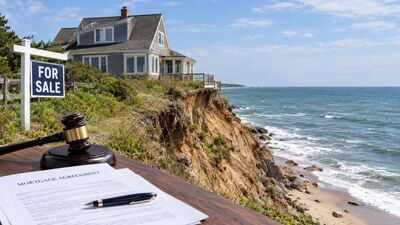
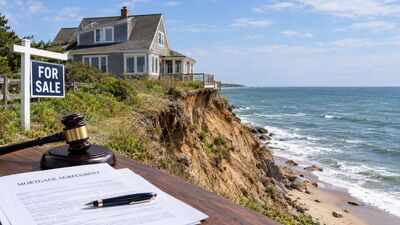
A Massachusetts coastal property became the centre of a legal dispute after its owner took out a $3.85 million mortgage on a house standing less than 14 feet from an eroding bluff above Cape Cod Bay. John Bonomi bought the Wellfleet property for $5.5 million in November 2021, but years of coastal erosion eventually forced him to demolish the house in early 2025. He has since taken JPMorgan Chase to court, arguing that the mortgage should be voided. The case raises questions about property valuations, lending decisions and the risks of buying homes along vulnerable coastlines.
Why is the $3.85 million mortgage on the eroding Massachusetts house being challenged
According to Realtor, Bonomi purchased the property at 1440 Chequessett Neck Road in Wellfleet, Massachusetts, after the house had already been identified as being at risk from coastal erosion. The foundation stood less than 14 feet from the edge of a bluff that had reportedly been retreating each year at the time of the sale.Despite the danger, Bonomi secured a $3.85 million mortgage from JPMorgan Chase to finance the purchase. The property, commonly known as the Blasch house after its original owners, had been built in 2010 by Mark and Barbara Blasch.The lawsuit, detailed by Lawsuit Bailbonds in its report on the case, identifies Bonomi as a retired New York attorney. He alleges that he lacked the mental capacity to enter into the mortgage agreement and that the bank took unfair advantage of his condition.JPMorgan Chase has denied the allegations. The bank maintains that it acted in good faith and followed reasonable commercial standards when providing the loan. The allegations have not been proven in court, and the dispute remains unresolved.
The property’s history reveals a long-running erosion problem
The threat to the house did not emerge suddenly after Bonomi bought it. Realtor reported that the original owners had been warned about the likelihood of severe erosion when they sought permission to build the property in 2010.From 2013 onwards, the Blasches placed large quantities of sacrificial sand beneath the property in an effort to slow the retreat of the bluff. They later sought permission to construct a 241-foot stone barrier, known as a revetment, to protect the land from further erosion.However, the town rejected the proposal, and the owners continued challenging the decision while the property was being prepared for sale in 2021.After purchasing the home, Bonomi continued the separate legal effort over the proposed coastal protection structure, according to Lawsuit Bailbonds. A Massachusetts court upheld the town’s decision in October 2023, and the complaint says a further appeal in 2025 left no practical way to challenge the rejection.The erosion continued despite efforts to protect the property. Realtor cited information from the Massachusetts Office of Coastal Zone Management indicating a long-term erosion rate of approximately 2.5-3 feet per year near the site. But periods of increased erosion, especially in the early and mid-2010s, meant the threat could change faster than long-term averages indicated.
The owner says the mortgage agreement should not stand
Lawsuit Bailbonds reported that Bonomi filed his case against JPMorgan Chase in the US District Court for the Southern District of New York in October 2025. The case, Bonomi v. JPMorgan Chase Bank, N.A., seeks to have the mortgage and the accompanying loan agreement declared voidable.The complaint presents 3 main claims. First, Bonomi was incapable of entering into the agreement because he was suffering from a prolonged manic episode related to bipolar disorder. He alleges that the bank knew, or deliberately avoided recognising, that he was not competent to sign the documents.The second ground is that the mortgage was unconscionable, i.e. the circumstances surrounding the agreement were so unfair that it ought not to be enforced. Bonomi alleges that the bank took advantage of his impaired mental state when approving the loan.The third claim seeks financial compensation for the losses he says followed from the agreement.According to Lawsuit Bailbonds, Bonomi paid approximately $21,053 a month towards the mortgage from November 2021 until September 2024, when he stopped making mortgage and property tax payments. The loan carried a fixed interest rate of 2.99% and was scheduled to mature in December 2051.His complaint seeks the return of approximately $695,000 in mortgage payments, alongside more than $750,000 in expenses associated with trying to preserve the property and eventually demolishing it.
Owner left with land, disputed loan after demolition
By the beginning of 2025, the danger of the house falling into Cape Cod Bay had grown so great that it needed to be torn down. Realtor reported that the house was removed before it could collapse into the water, while Lawsuit Bailbonds placed the demolition in February 2025.The complaint estimates that demolition cost approximately $250,000. The figures represent the owner’s claims rather than amounts awarded by a court.The financial position of the property also changed considerably. According to Lawsuit Bailbonds, the town of Wellfleet assessed the property at more than $4.38 million in 2021. By January 2025, the land was assessed at $385,000, reflecting the dramatic change in its circumstances after the house was lost. Bonomi still owns the land, according to the report.
The case highlights questions about coastal property lending
The dispute also draws attention to the difficulties involved in assessing homes exposed to coastal hazards. Realtor explained that waterfront properties can retain considerable market value because buyers are willing to pay for ocean views, access to the water and desirable locations, even when erosion presents a serious risk.Often property valuations are based on comparable sales in the locality. If other vulnerable coastal homes continue selling for high prices, those transactions can support substantial valuations despite the underlying environmental danger.Standard mortgage appraisal guidelines don’t always require appraisers to predict how long a property will last.They typically document the condition of the property and form an opinion about its value and marketability, and it is up to the lender to determine if further inspections are needed.Flood assessments may not fully capture the problem either. The Federal Emergency Management Agency does not include long-term bluff erosion in its standard coastal flood analysis. A property’s flood designation therefore does not necessarily indicate how quickly the land beneath it is disappearing.As of September 2026, Lawsuit Bailbonds reported that JPMorgan Chase had filed its response, denying the allegations, and that the case remained in the pretrial stage without a ruling on the merits or a reported settlement.