







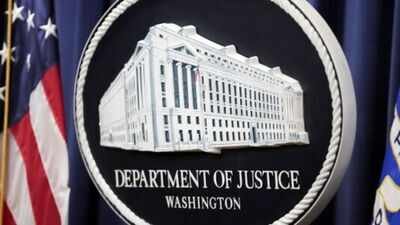
US President Donald Trump’s Justice Department has stepped into election disputes ahead of Tuesday’s US midterm elections, breaking with decades of practice aimed at keeping federal law enforcement agencies from appearing to favour a political party or candidate.The department has filed lawsuits challenging election procedures in California and Alaska, raising concerns among critics that its powers are being used to influence contests that could determine control of Congress and several governors’ offices, Reuters reported.In California, the Justice Department sought to block mail-in ballots from around 20,000 voters it suspects may be non-US citizens and therefore ineligible to vote. It has also demanded election records as part of a related criminal investigation.California officials have rejected the move, saying the state has safeguards to prevent noncitizens from voting and arguing that the federal government lacks the authority to block the ballots.In Alaska, the department has stepped up a criminal investigation into whether a Senate candidate sharing the name of Republican incumbent Dan Sullivan entered the race to confuse voters. It also moved to prevent certification of the election result if Sullivan narrowly loses.However, a federal judge dismissed the department’s lawsuit on Sunday, ruling against its attempt to intervene in the state’s election process. The Justice Department has appealed the decision.According to Reuters, courts have now rejected the department’s lawsuits involving both California and Alaska. The cases have highlighted the Trump administration’s willingness to intervene in election disputes before ballots are counted and results are certified.Critics have warned that such moves could give Trump an opportunity to question the legitimacy of the midterm results.“It appears that the administration wants the department to have an impact that was previously prohibited,” Mark Blumberg, who formerly led the Justice Department’s election response to civil rights threats, was quoted as saying by Reuters. He has since founded the Rule of Law Project.Attorney General Todd Blanche has defended the department’s actions, saying they are lawful and intended to protect election integrity.“The Department isn’t helping any campaign. It’s enforcing the law,” Justice Department spokesperson Kiersten Pels said.
Trump’s claims of voter fraud
Under the US Constitution, individual states are responsible for administering elections. However, Trump has repeatedly accused Democratic-led states of failing to prevent noncitizens from voting, although voting by non-US citizens is already prohibited under federal law.Trump has also continued to make false claims that widespread voter fraud cost him the 2020 presidential election. Independent investigations and state audits have found that voter fraud is rare.During his first term, Justice Department officials resisted pressure to intervene in efforts to challenge Trump’s 2020 election defeat. Outside groups aligned with the Republican leader subsequently filed more than 60 lawsuits disputing the results, but none succeeded.Lis Frost, a voting rights lawyer with Elias Law Group, which frequently represents Democrats in court, said the situation had changed.“The right-wing fringe outside groups are not going to have to do that this year because the DOJ is clearly standing ready and willing to do it,” Frost told Reuters.Traditionally, the Justice Department’s election-related interventions have focused on enforcing federal laws that protect the voting rights of racial minorities and other vulnerable groups.
Alaska election becomes legal battleground
Alaska has emerged as a major focus of the dispute following a New York Times report that Democratic candidate Mary Peltola’s campaign was involved in recruiting retired teacher Daniel J Sullivan to challenge Republican Senator Dan Sullivan.The Justice Department’s lawsuit, which Trump said he had directed the department to file, sought to halt certification of the results and order an investigation if the victory margin indicated that voter confusion could have affected the outcome.However, US District Judge Sharon Gleason in Anchorage dismissed the case on Sunday, saying Alaska could not conduct such an investigation while maintaining the secrecy of ballots.Legal experts had questioned whether the Justice Department had the authority to pursue the case, warning that the move could create the impression that the federal government was favouring the Republican incumbent.Peter Keisler, who served as acting attorney general under former Republican President George W Bush, said the department needed to maintain political neutrality to retain public trust.“For the department to be trusted in its law enforcement decisions it has to ensure that people understand it does not take sides in political partisan disputes,” Keisler told Reuters.He added that the Alaska case had not only created the appearance of political interference but also represented an evident instance of taking sides.Blanche has defended the lawsuit, alleging that Daniel J Sullivan was involved in an attempt to mislead voters. The candidate has denied trying to confuse voters, while Peltola’s campaign said it had “no involvement with either Sullivan campaign”.Responding to criticism, a Justice Department official said during a press briefing on Thursday that the department filed lawsuits to enforce federal law.
Trump allies gain greater control over election investigations
The Justice Department has traditionally exercised caution in election-related investigations because federal intervention can create uncertainty and potentially be used by political candidates to challenge results.Its Public Integrity Section, which has career officials specialising in election law, previously advised investigators and prosecutors to wait until election results were certified before taking action, according to former department officials cited by Reuters.However, the Trump administration has reduced the size of the unit and suspended a requirement that federal prosecutors consult it during investigations into election-related corruption.Justice Department officials have argued that individual US attorney’s offices are better placed to determine whether criminal charges should be pursued.According to three people familiar with internal discussions, agents and prosecutors have instead been told that political appointees of the Trump administration will decide unresolved disputes.The Deputy Attorney General’s Office is also expected to mediate disagreements between investigators and prosecutors, a role former Justice Department officials said it has rarely played in election investigations.Pels defended the arrangement, saying resolving disputes that cannot be settled at the local level was precisely the purpose of the office.