








A riverfront home can face years of damage from erosion and moving water, making protective structures an important investment for homeowners. But when a barrier built to safeguard a property fails during a flood, the consequences can extend far beyond the cost of replacing it. One Louisiana homeowner experienced this after a wooden river barrier collapsed, leaving her house structurally compromised and requiring hundreds of thousands of dollars in repairs.The Louisiana Court of Appeal, Third Circuit, addressed the dispute in its October 30, 2026, decision in Elizabeth D. Molbert v. Kenko Bulkhead & Marine Services, LLC, et al., available on Justia. The court examined the contractor’s responsibility for the failed construction, the homeowner’s share of fault and the extent of the contractor’s insurance coverage. It ultimately removed the homeowner’s share of responsibility, increased her mental anguish compensation and revised the damages awarded, bringing her total recovery to $448,431.34.
A $32,500 bulkhead was built to protect the riverfront property
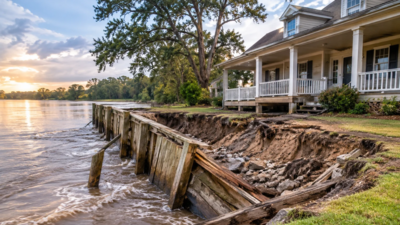
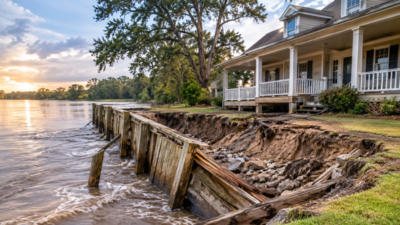
Elizabeth Molbert purchased her home along the west fork of the Calcasieu River in 2009 for $109,000. Several years later, concerned about erosion caused by the river’s moving water, she hired Kenko Bulkhead & Marine Services LLC to construct a 130-foot wooden bulkhead. The structure, completed in June 2016, cost $32,500. Its purpose was to prevent the riverbank from eroding and protect the house from the effects of the moving water.However, the bulkhead failed during a flood in May 2017. Molbert subsequently discovered that the consequences extended beyond the damaged river barrier. Because Kenko had connected the original wooden bulkhead to a piling supporting the house, the structure’s failure caused the house to shift. Molbert filed a claim under her flood insurance policy with Liberty Mutual. An appraisal determined that her losses exceeded the policy limit, and the insurer paid her $165,000. She also replaced the failed wooden structure with an engineered steel bulkhead, which cost $167,058.59. Repairs to her house added another $266,372.75 to her expenses.
Homeowner sued contractor over defective construction
In March 2018, Molbert filed a damages lawsuit against Kenko and its insurer, Travelers Property Casualty Company of America. She alleged that defective construction of the bulkhead had caused the damage to her property. She later amended her lawsuit to include Kenko’s owners, Kenneth Cooley and Glenn Beier. Among her allegations was that the two men had assured her they were licensed contractors and legally qualified to perform the work, although they did not have the required licences.The case went to a jury trial in September 2024. The jury assigned 75% of the responsibility for the damages to Kenko, Cooley and Beier collectively, while finding Molbert 25% at fault. It awarded her $266,372.75 for damage to the house, $167,058.59 for the bulkhead and shoreline, $2,500 for loss of enjoyment of life and $7,500 for mental anguish. After reducing the award to account for her 25% share of fault, her recovery was calculated at $332,573.50. The trial court subsequently dismissed the claims against Cooley and Beier in their individual capacities. The homeowner, contractor and insurer all appealed.
Appeals court examined licensing and insurance coverage
A central issue before the appeals court was whether Travelers could avoid covering the damages under exclusions in its commercial general liability policy. The insurer argued that the policy’s breach-of-contract exclusion applied because the dispute arose from the agreement to construct the bulkhead. However, the appeals court found that the exclusion did not prevent coverage because Kenko did not hold the required licences to perform the contracted work. Under Louisiana law, a construction contract entered into in violation of licensing requirements can be considered an absolute nullity.The judges also examined the policy’s work-product exclusion. They ruled that Travelers’ policy excluded the $167,058.59 cost of repairing and replacing the defective bulkhead itself. The court also clarified that the jury’s award under the combined ‘shoreline/bulkhead’ category represented bulkhead replacement costs alone, as Molbert had not restored the shoreline. However, the damage to Molbert’s house was covered under the policy’s products-completed operations hazard provision because it involved damage to other property after the construction work had been completed. The policy did not cover the mental anguish award, a finding by the trial court that remained undisturbed on appeal. Thus, although Molbert’s total damages award increased to $448,431.34, Travelers’ coverage did not extend to the entire amount.The court also rejected Kenko’s argument that the homeowner’s $165,000 flood insurance payment should be deducted from her recovery. It explained that Molbert remained entitled to pursue the unpaid portion of her damages, although she would have to reimburse Liberty Mutual in accordance with the policy’s subrogation clause.
Court removes homeowner’s fault and increases compensation
One of the most significant findings concerned the jury’s decision to hold Molbert 25% responsible for the damage. The appeals court found that the evidence overwhelmingly established that the bulkhead failed because of improper design and construction. Experts testified that the structure lacked necessary rock protection, proper soil compaction and sufficient height. These deficiencies contributed to the failure, and none of the experts attributed fault to Molbert.The contractor had also argued that she should have removed a temporary stabilisation beam attached to the house piling. However, the court said she was a homeowner who had hired marine construction professionals and could not reasonably have been expected to understand the structural risks. It therefore removed her share of fault entirely. The court also increased her mental anguish award from $7,500 to $15,000. It considered her financial difficulties, including withdrawing retirement savings, taking additional jobs and delaying retirement to pay for the repairs. However, it removed the separate $2,500 award for loss of enjoyment of life, finding insufficient evidence to support such compensation without physical injury.The final judgment awarded Molbert $266,372.75 for damage to her home, $167,058.59 for replacement of the bulkhead and $15,000 for mental anguish, bringing her total damages award to $448,431.34. The court also ordered Kenko and Travelers to bear 100% of the trial court costs, expert witness fees and transcript costs.