









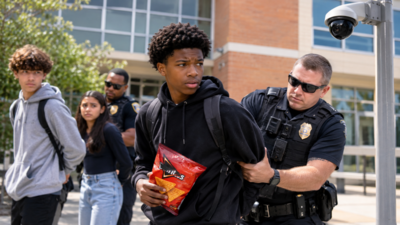
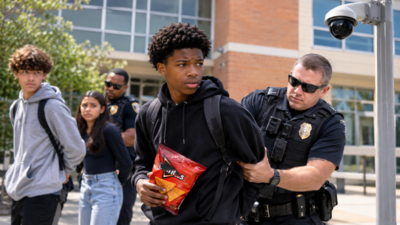
A bag of Doritos was all one teenager had in his hands while waiting outside his school after football practice. But an artificial intelligence-powered security camera interpreted the packet as a firearm, setting off a chain of events that brought several armed police officers to the Maryland school. Four teenagers were ordered to their knees, handcuffed and searched, even though the alert had already been cancelled after officials identified the object as a bag of crisps. Now, the students are taking legal action against their school district, the surveillance technology company and others, alleging that a preventable technology error led to an unlawful police encounter.
How a packet of Doritos triggered a police response outside Kenwood High School
As reported by Lawyers’ Committee for Civil Rights Under Law, the incident dates back to October 20, 2025, when four students were spending time outside Kenwood High School in Baltimore County, Maryland, after football practice. According to a civil rights complaint, Taki Allen was eating Cool Ranch Doritos that had been handed out by his coach. The other three students, Yui-Osa Ogbeide, Devon Thompson Jr. and Keith Winfield III, were with him.The school district was using Omnilert Gun Detect, an AI-based weapons detection system connected to its existing security cameras. Shortly before 7:04 pm, the software identified the packet in Allen’s hand as a possible firearm, assigning the image a 90% confidence score. The alert was then passed on to the company’s human review team, which also failed to identify the object correctly and forwarded the warning to school personnel.The first response from school safety officials and a Baltimore County police sergeant was different. After examining the footage, they recognised that the supposed weapon was actually a bag of chips. The alert was cancelled within approximately two minutes of being generated, according to the lawsuit. A cancellation message was sent to the original recipients, while the system’s online dashboard also reflected that the warning had been withdrawn.
How a cancelled AI alert still led to six police cruisers arriving at the school
The complaint alleges that Kenwood High School principal Catherine ‘Kate’ Smith subsequently looked at the original image without taking account of the cancellation notice. Reportedly, more than 10 minutes after the alert had been withdrawn, she reportedly sent a screenshot to the school’s resource officer. In a message to other administrators at around 7:19 pm, Smith allegedly indicated that the person shown in the image was still outside the school and appeared to be armed. The resource officer then passed the screenshot to Baltimore County police. Officers were dispatched at approximately 7:21 pm to investigate a report of someone carrying a weapon.At least six police vehicles arrived, according to the filing. Several officers approached with their firearms drawn. The four teenagers raised their hands, but were instructed to get down on their knees. They were handcuffed and subjected to searches of their bodies and belongings. The lawsuit maintains that none of the students had behaved suspiciously or committed an offence. Three of them, it says, were not even visible in the original image that had triggered the AI alert.When Thompson questioned why he was being detained, an officer allegedly explained that he was being held because he had been with Allen. The complaint reproduces the officer’s response as, ‘You were just with him, ok, so guilty by association if you want to say that.’
Police discovered the supposed weapon was a packet of chips
The searches produced no firearms. Officers subsequently examined the original surveillance image and compared it with empty Doritos packets found in a nearby rubbish bin. The object identified by the software was confirmed to be a bag of crisps. The complaint says one officer acknowledged that the AI system had mistaken the food packaging for a gun. As the officers prepared to leave, another reportedly expressed frustration with the surveillance equipment, referring to the cameras as ‘stupid AI cameras’.There was also an exchange that the students’ lawyers have included in their account of what happened afterwards. The supervising officer, Corporal Michael Foehrkolb, allegedly thanked the teenagers for not running away, adding that doing so would have created a serious problem.The complaint also describes the physical and emotional effects of the encounter. The students say they were frightened as officers approached with guns, unsure whether even a sudden movement might put them in greater danger. Their handcuffs reportedly left marks and caused pain. Thompson also told officers that the restraints were aggravating an existing wrist injury, but the complaint alleges that his concerns were not addressed by loosening them. The consequences did not end when the police left. The teenagers describe anxiety around law enforcement and discomfort about remaining on school grounds after normal activities. Allen, who is still a student at Kenwood, reportedly began arranging paid rides home rather than waiting outside the building after practice.
Four students take school district and AI company to court over false gun alert
The filing also refers to messages exchanged between Smith and the school resource officer after it became clear that the object was not a firearm. In one exchange described in the complaint, the officer reportedly explained that it was a ‘bag of chips not a gun’, adding a laughing emoji. Smith allegedly responded with ‘Bwahahaha’. The students argue that the response points to wider problems in the way the school handled the incident. Their complaint is not limited to the AI system’s inability to distinguish food packaging from a weapon. It also questions why a warning that had already been withdrawn was allowed to prompt a police deployment.The civil rights action was filed on November 17, 2026, in Baltimore County Circuit Court. The four plaintiffs are represented by the Lawyers’ Committee for Civil Rights Under Law, alongside Willkie Farr & Gallagher LLP and Engel Law Group, P.C.The defendants named in the case include Omnilert LLC, Baltimore County Public Schools, Baltimore County, school administrators and individual police officers. The claims include alleged violations of the Fourth and 14th Amendments, protections under the Maryland Constitution, false imprisonment and negligence. These are allegations presented in the complaint and have not been established through a court ruling.
How repeated false gun alerts raised questions about AI surveillance in schools
The case also brings attention to the scale at which the school district had adopted automated weapons detection. According to the complaint, Baltimore County Public Schools introduced Omnilert Gun Detect across 165 schools between autumn 2023 and spring 2024. The technology was connected to more than 7,000 security cameras already operating across the district.The system is marketed as a way to identify firearms through surveillance footage while distinguishing them from everyday objects. However, the students’ lawyers cite findings from Maryland’s Office of the Inspector General for Education indicating that more than 99% of the alerts produced by the system in Baltimore County schools were false positives that did not require police intervention.The complaint also refers to previous police responses to alerts involving objects that were not guns. These allegedly included children’s toys, a stapler and a glue gun. The plaintiffs argue that repeated problems should have prompted stronger procedures for reviewing warnings and ensuring that cancelled alerts reached everyone who might act on them.They further allege that the district did not provide sufficient training or establish a reliable method of communicating cancellations to school administrators and law enforcement personnel. In their account, the October 2025 detention was connected not only to a mistaken identification but also to failures in the handling of information after the mistake had been recognised. Omnilert reportedly maintained after the incident that its process had functioned as intended.
Students seek changes to school security and police procedures
Damon Hewitt, president and executive director of the Lawyers’ Committee for Civil Rights Under Law, said the students had been let down by both the technology and the adults responsible for responding to the alert. He argued that automated systems could create serious problems when officials rely on their warnings without properly checking the information or coordinating with one another.Leah Frazier, director of the organisation’s Digital Justice Initiative, also raised concerns about the use of AI surveillance around young people. She said safeguards and clear expectations for the adults handling these systems were necessary as their use expanded in schools and other public settings.Freida Winfield, the mother of student Keith Winfield III, described the experience from a parent’s perspective. She questioned why her son had been exposed to an armed police response while simply waiting outside his school for a ride home.The plaintiffs are seeking financial compensation as well as court-ordered changes to the way AI-generated security alerts are handled. Their requests include proper verification before police are dispatched, effective communication when an alert is cancelled, improved staff training and greater oversight of the technology’s performance.They are also calling for more transparency and community involvement in decisions about the use of AI surveillance in schools. According to the complaint, Omnilert Gun Detect remains in operation at Kenwood High School, while the students maintain that the shortcomings that contributed to their detention have not been adequately addressed.Disclaimer: This article is based on publicly available reports by The New York Times and a civil rights lawsuit filed by the Lawyers’ Committee for Civil Rights Under Law. The Times of India has not independently verified the allegations made in the complaint.