










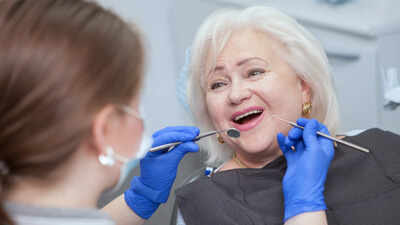
Monica Frain, a Broome resident, noticed a small lump on her tongue in late 2022. Her GP reportedly told her to bite it off, but a routine dental check-up changed the course of events. Her dentist flagged the growth and referred her to a specialist, who diagnosed tongue cancer, ABC News reported. Frain underwent five hours of surgery to remove more than a third of her tongue.
Her GP told her to bite it off
Monica Frain first noticed a pinhead-sized lump on her tongue in late 2022. For months, the lump bothered her. In fact, she grew more annoyed than alarmed. She had recently undergone cardiac surgery and assumed that the lump could have been caused by the breathing tube placed during the procedure. She consulted a local general practitioner, who assured her there was nothing to worry about. In fact, the GP told her to bite the lump off.A routine dental examination flagged the growthAfter the GP’s consultation, Monica Frain went for a routine dental check-up. Dentist Stephanie Mulcahy saw the lump and did not wait to see whether it would go away. She immediately referred Frain to an oral medicine specialist. “While it didn’t look sinister, I wanted confirmation of what it was,” Dr Mulcahy told the broadcaster.
The cancer diagnosis
Getting a specialist opinion is difficult in Broome and across the Kimberley, the far north of Western Australia. Most specialists fly in from Perth, which is about 2,240 kilometres south, and work to a strict rotating schedule. Since Dr Mulcahy told her it wasn’t ideal to wait, Frain flew to Perth in early 2023. She consulted an oral medicine specialist, who ordered a biopsy. The result showed squamous cell carcinoma (SCC). It is the most common form of tongue cancer, according to Cancer Research UK. Squamous cells are flat, skin-like cells that cover the lining of the mouth, nose, larynx, thyroid and throat. Since the cancer was detected early, it had not spread, and surgery was sufficient to treat it. However, the procedure still meant removing more than a third of her tongue. The surgery lasted five hours.
Why abnormal lumps should not be dismissed
Frain says she is ‘extremely grateful’ to Dr Mulcahy for her medical advice. “If Dr Steph had not pushed for me to go and see a specialist and have it removed, I could have been in a terrible state,” she told the broadcaster.For Dr Mulcahy, though, it was simply part of her responsibility as a dentist to investigate anything that appeared unusual and ensure her patient received the right care. She has seen how these cancers can progress. She has identified tongue cancer in other patients, and one of them died of the disease.Oral and maxillofacial pathology specialist Omar Kujan told the broadcaster that Frain’s case shows how much timing matters. “Regular dental check-ups can save lives by identifying early warning signs that people may not notice themselves,” Dr Kujan said.The specialist also added that oral cancer can develop without pain or obvious symptoms. “Early diagnosis significantly improves the chances of successful treatment and survival. Timely access to oral healthcare must be a priority, particularly in regional and remote Australia.”Tongue cancer is a type of head and neck cancer. Symptoms include a spot or lump on the tongue that does not go away. Smoking, alcohol consumption and infection with human papillomavirus (HPV) are some of the risk factors.