






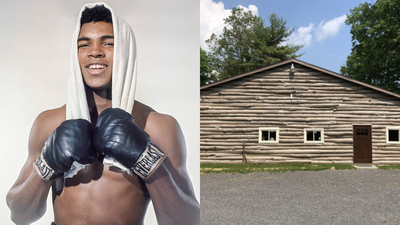
In 2016, real estate investor Mike Madden paid $520,000 for Muhammad Ali’s former training camp in Pennsylvania, a property that had fallen into disrepair after the boxing legend left it decades earlier. Madden subsequently invested another $1 million in restoring its 13 log structures, including the gymnasium and mosque, before reopening the six-acre site as Fighter’s Heaven in June 2019. According to Pennsylvania Heritage Magazine, the restoration sought to recreate the camp as it appeared when Ali trained there, turning a once-private sporting retreat into a place where visitors could explore the life and career of one of boxing’s most celebrated figures.
The secluded camp where Ali prepared for his biggest fights
Located near Orwigsburg in Schuylkill County, Pennsylvania, Fighter’s Heaven was established by Ali in 1972. The heavyweight champion wanted a secluded base where he could train away from the distractions of crowded gyms and the media attention that followed him. The idea came from Gene Kilroy, Ali’s business manager and a key figure in his professional career. Kilroy believed a remote training centre would give the boxer greater privacy while helping him control the costs of preparing for fights.Ali purchased approximately six acres of land after using a nearby property to prepare for earlier bouts. He then commissioned a collection of log buildings designed to function as a self-contained training community. The complex included a regulation-size boxing ring, Ali’s personal cabin, a kitchen and dining building, bunkhouses for sparring partners, a stable and a small mosque. A horse-drawn covered wagon, mobile homes for members of his team and other facilities also formed part of the camp.Ali trained there for many of his major fights between 1972 and 1981. These included bouts against Joe Frazier, George Foreman, Ken Norton and Floyd Patterson. The site also welcomed younger fighters, including Larry Holmes and Tim Witherspoon, who trained alongside or learned from Ali.The camp became known as Fighter’s Heaven in 1973, a name that reflected Ali’s affection for the secluded retreat and its importance to the boxing world.
From abandoned property to a $520,000 purchase
After Ali stopped using the camp in 1981, the property entered a period of uncertainty. It remained largely vacant until 1997, when George Dillman, a karate instructor who had previously taught Ali, purchased it for $114,000. Dillman invested approximately $400,000 in repairs and operated the property as a martial arts school and a bed-and-breakfast establishment known as Butterfly & Bee. However, maintaining the complex eventually became difficult, and the property was put up for sale in 2002.Years later, Madden came across the former camp while searching online for information about Ali. The discovery stayed with him, and he travelled from California to Pennsylvania to see the property in person. Following Ali’s death on June 3, 2016, Madden decided to purchase the camp and preserve its history. He paid Dillman $520,000 in July 2016, according to Pennsylvania Heritage Magazine.Madden, the son of former Oakland Raiders coach and NFL broadcaster John Madden, had not initially developed a detailed commercial plan for the site. Instead, he saw an opportunity to protect a place associated with an important chapter in sporting history. “I think it’s a calling,” Madden said of the project in an interview published on Fighter’s Heaven’s website.
Restoring 13 log structures to their former appearance
The restoration required more than repairing a collection of ageing buildings. Madden wanted the site to resemble the camp Ali had used during the 1970s, rather than turning it into a modern museum detached from its original character. He spent approximately $1 million on the project, bringing craftsmen and former members of Ali’s circle into the process. Amish craftsmen helped restore several of the buildings, while historical photographs and personal recollections guided decisions about furnishings, equipment and the arrangement of the interiors.The gymnasium became a central feature of the restored site. Its boxing ring occupies the same location as Ali’s original ring, while photographs, fight posters and video displays document the boxer’s career.Ali’s personal cabin was also recreated using period-style furniture, with exhibits offering insight into how he lived during training camps. The kitchen retains its original long wooden dining table and gas stove, while a reproduction of the rules once associated with Ali’s aunt Coretta, who cooked at the camp, forms part of the display.The small mosque where Ali prayed was restored as well. Elsewhere, the property’s painted boulders preserve the names of boxers admired by Ali. His father, Cassius Clay Sr., painted the names on the rocks, giving them an additional connection to the family’s history.
Reopening the camp to visitors
Fighter’s Heaven held its grand reopening ceremony on June 1, 2019, attended by Madden, Kilroy and former heavyweight champion Tim Witherspoon. Public visits began later that month, allowing people to explore the buildings and learn about Ali’s training routines and life away from the ring. The restoration also received recognition from Pennsylvania’s State Historic Preservation Office. In November 2019, the office named Fighter’s Heaven among its Community Initiative Award recipients, recognising efforts to preserve historic places across the state.By March 2023, the camp’s official newsletter reported that thousands of visitors had toured the property since its reopening. The site had also hosted documentary crews working on productions about Ali, including Ken Burns’ documentary series Muhammad Ali and HBO’s What’s My Name: Muhammad Ali.The newsletter also documented a heritage time capsule buried at the property in 2022, marking 50 years since Ali established the camp. Scheduled to be opened in 2072, the capsule contains photographs, articles, memorabilia and information about the restoration.