










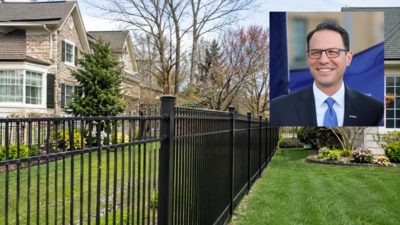
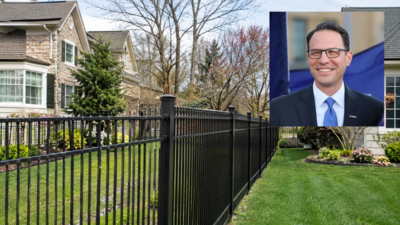
A proposed security upgrade at Pennsylvania Governor Josh Shapiro’s private residence has escalated into a legal battle with his neighbours over a roughly 2,900-square-foot strip of land in Abington Township. Jeremy and Simone Mock accuse Shapiro and his wife, Lori, of occupying their property without permission and using state police to restrict their access. The Shapiros, who purchased their home in 2003, argue that they have maintained the disputed area for more than two decades and claim ownership under Pennsylvania’s adverse-possession law. The disagreement led to two lawsuits filed on February 9, 2026, with both households seeking legal recognition of their respective claims. The dispute followed an arson attack on the governor’s official residence in April 2025.
How an 8-foot security fence sparked a land dispute
The disagreement began in 2025 when Pennsylvania State Police recommended additional security measures at Shapiro’s private residence in Abington Township, Montgomery County, following an arson attack on the state-owned Governor’s Residence in Harrisburg on April 12, 2025.As part of the proposed security improvements, authorities recommended installing an eight-foot fence around the governor’s private property. However, a survey conducted during the summer of 2025 revealed that approximately 2,900 square feet of land near the boundary between the two properties appeared to fall within the Mocks’ property deed.The Shapiros had believed the disputed area belonged to them since purchasing their home in 2003. Their neighbours, Jeremy and Simone Mock, bought their adjoining property in 2017.The discovery complicated the proposed fence installation because part of the planned security perimeter would have extended onto the neighbours’ land.
Why the neighbours challenged Shapiro’s ownership claim
According to the Mocks’ February 2026 lawsuit, the Shapiros approached them in July 2025 to discuss purchasing a portion of their property for the proposed security fence. The two households also considered a possible leasing arrangement.However, negotiations broke down after they failed to agree on a price. The Mocks’ complaint alleges that the Shapiros subsequently indicated they would pursue alternative means of acquiring the disputed area.The neighbours maintain that the land belongs to them because it falls within their property deed. They also argue that they have paid property taxes on the disputed section since purchasing their home.The Mocks further contend that the Shapiros’ initial offer to purchase or lease the land indicated that they knew it was outside their property’s legal boundaries. The Shapiros, however, maintain that their longstanding use of the area gives them a legal claim to ownership.
Shapiro invokes Pennsylvania’s 21-year adverse-possession law
At the centre of the disagreement is a legal principle known as adverse possession, which can allow someone to acquire ownership of land belonging to another person after meeting specific conditions for a prescribed period.In Pennsylvania, the required period is generally 21 years. A person claiming ownership must establish actual, continuous, exclusive, open, notorious and hostile possession of the property.The Shapiros argue that they have satisfied these requirements because they have maintained and treated the disputed area as part of their property since purchasing their home in 2003.Their court filing states that an existing fence and a line of trees reinforced their understanding of where their property ended. They also argue that the neighbours did not previously use or maintain the disputed area.The Mocks challenge this interpretation, maintaining that the land belongs to them under the recorded property boundaries. The court will ultimately have to determine whether the Shapiros have met the legal requirements to establish ownership through adverse possession.
Neighbours accuse governor of using state police to restrict access
The disagreement escalated beyond the proposed fence when the Mocks accused the governor and his wife of occupying the disputed area without permission and interfering with their use of the property.Their federal lawsuit alleges that the Shapiros began planting arborvitae trees and other vegetation on the disputed section, flew drones over their property and threatened to remove healthy trees.The complaint also accuses Shapiro of directing Pennsylvania State Police personnel to patrol the area. According to the neighbours, troopers repeatedly instructed them to leave the disputed section, describing it as a security zone.The Mocks further allege that their contractors, surveyors and other workers were prevented from accessing parts of the property.They asked the federal court to stop the Shapiros and their representatives from occupying the disputed land and sought damages over the alleged interference with their property rights.
Shapiro and his wife file a countersuit
On February 9, 2026, the same day the Mocks filed their federal lawsuit, Josh and Lori Shapiro filed a separate property lawsuit against their neighbours in the Montgomery County Court of Common Pleas.The Shapiros asked the court to recognise them as the legal owners of the disputed parcel through adverse possession.Their complaint also accused the Mocks of interfering with their use of the property and creating security concerns. They alleged that the neighbours attempted to construct their own fence that would encroach on the disputed section, posted signs claiming ownership and contacted local police over the disagreement.The Shapiros sought a court declaration establishing their ownership and an injunction preventing the neighbours from interfering with their use of the land. They also sought reimbursement of legal expenses.The Mocks, meanwhile, maintained that the property belonged to them and sought legal protection against what they described as unauthorised occupation.
The proposed security fence was never installed
Despite triggering the disagreement, the eight-foot security fence was ultimately never erected at the governor’s Abington residence.According to reporting by The Philadelphia Inquirer and Spotlight PA, the fencing had been purchased but was later repurposed for use at the Pennsylvania State Police training academy.Instead, contractors hired by the state began planting arborvitae trees and other vegetation as part of the security improvements.The wider security upgrade at Shapiro’s private residence also attracted scrutiny over public spending. Spotlight PA reported that the improvements, including extensive landscaping, cost nearly $1.1 million in taxpayer funds.The expenditure prompted questions from Republican lawmakers about the transparency surrounding the security work and the use of public money for improvements to a private residence.
What did the federal court decide?
On July 7, 2026, US District Judge Harvey Bartle III issued a ruling on the neighbours’ federal lawsuit, distinguishing between Shapiro’s position as governor and his role as a private homeowner.The judge dismissed claims against Shapiro in his official capacity as governor and against the acting Pennsylvania State Police commissioner in his official capacity. However, the lawsuit against Shapiro personally and his wife was allowed to proceed.The court also dismissed the claims brought under a separate federal civil-rights provision, Section 1985.Importantly, the ruling did not determine who legally owned the disputed parcel. It addressed which claims could proceed in federal court, leaving the underlying ownership question unresolved.The judge also rejected the Shapiros’ request to pause the federal proceedings at that stage, allowing the remaining claims to continue.
Federal judge pauses proceedings in November
The latest significant development came on November 3, 2026, when a Pennsylvania federal judge stayed the proceedings in the property dispute, according to a report by Law360.The case, filed in the US District Court for the Eastern District of Pennsylvania, involves the Mocks’ allegations against the Shapiros and their competing claims over the disputed land.A stay temporarily puts court proceedings on hold but does not amount to a decision on the ownership question or establish that either household has won the dispute.The separate lawsuit filed by the Shapiros in Montgomery County seeks to establish legal ownership of the parcel through adverse possession. The competing claims over the 2,900-square-foot area therefore remain central to the wider legal battle.